











































The State Food and Veterinary Service is asking small-scale producers what they find unclear: farmers say the problem is not just a lack of information
The State Food and Veterinary Service (VMVT) has launched a survey inviting small-scale food producers to identify which legal requirements cause them the most confusion. The Service itself acknowledges that a lack of clarity regarding food safety, hygiene or labelling rules may hinder the operations of small producers or require additional time and financial resources.
However, the small-scale food producers interviewed say that the problem does not always lie solely in the provision of information. For some of them, the main concerns relate to how the requirements are applied in practice, the amount of paperwork involved, and whether the checks are actually proportionate to small-scale production.
“At the beginning, even the State Food and Veterinary Service (VMVT) didn’t know where to start”
Genovaitė Sakalauskienė, a farmer specialising in fruit and berry processing, started her business in 2016. She recalls that at the time, this type of activity was still relatively new.
“The start was difficult because none of the farmers were involved in processing – there were only dairy processors, and nobody was processing fruit or berries. It really was difficult because even the State Food and Veterinary Service (VMVT) didn’t know where to start. There were no regulations in place, &
“I drew up the rules myself, according to which I would operate, and obtained a licence. I wouldn’t say it was a huge challenge,” she says.
Today, according to G. Sakalauskienė, there is certainly no shortage of requirements and paperwork, especially when it comes to organic farming.
“There are additional requirements when you’re involved in organic production. The controls aren’t so much stricter, but simply different. There are plenty of requirements, paperwork and, of course, red tape, but that’s the case everywhere,” says the farmer.
“The requirements are the same as those for large companies,”
Another dairy farmer from the Marijampolė region, who asked not to be named, says that small-scale producers face the most issues when the requirements appear to have been carried over from the practices of larger companies.
“They always demand financial resources. From my experience, the main problem was that the requirements are applied in exactly the same way as for large companies,“ the farmer explains.
As an example, he mentions the traceability and batch number requirements.
“Specifically, I came up against the requirements for traceability and batch numbers – I was required to prepare in the same way as large companies do. I was surprised, because I really didn’t know how to meet such criteria,” says the interviewee.
However, he emphasises that he does not believe all the requirements are excessive.
“I can’t say that the requirements are excessive. It’s just that some of the logbook entries – well, some of them might as well not be there, because in reality they don’t change the situation,” – notes the farmer.
“Some logbooks don’t improve anything, they just take up time“
A dairy processor says that it is the mandatory record-keeping logs that raise the most doubts.
“For example, recording the temperature of milk in the fridge. Perhaps they just need to tick some boxes on paper, but in reality – which producer wants their milk to go off? Not a single one,” he says. According to him, the ultimate responsibility still lies with the producer themselves.
“If the milk has gone off and you need, for example, to make cheese, well, you can’t make anything from spoiled milk. The milk is poured away. That’s why some of these records, and the process of filling them in, don’t improve anything, but just take up time,” says the farmer.
“In reality, the documentation should be reviewed and assessed; some of it is certainly superfluous. For example, the rodent logbook, the milk cooler logbook, and the logbook for recording temperatures in other rooms &
“I’d say 70 per cent is about monitoring and 30 per cent is about advising,”
Although the farmer says that inspections on his farm usually went smoothly, he nevertheless believes that the authorities’ activities involve more monitoring than advising.
“I’d say about 70 per cent is about monitoring and 30 per cent is about advising. And they only advise when they find something on your farm and tell you where to look it up,” says the interviewee. He also recalls his experience with labelling.
„I had lots of questions about labelling at the start; I went to the State Food and Veterinary Service, we agreed on the labelling, I made the labels, drove to another town to sell my goods, and they said – ‘That’s not right; put those labels aside.’ After I asked them to put the requirements in writing, they refused to do so. I had to throw away all the labels and make new ones, even though the first ones had already been approved by the VMVT“, – says the farmer. According to him, it would be good if the inspections were at least partially coordinated.
“On more than one occasion, I’ve simply had to change my plans because of the inspectors turning up. I’m certain that if things were in a bad state, they’d find faults even if they’d arranged the visit in advance. If you don’t have the necessary equipment or the walls are crumbling, you can’t fix it in a week or two,” says the dairy processor.
Proposal to allow livestock to be slaughtered on the farm
Farmer Valentas Streikus says he didn’t have any major problems filling in the paperwork online.
“Whatever I filled in online – it was all straightforward. You fill in the forms, submit them, and that’s it,” he says. However, in his view, it would be important for small-scale producers to have more opportunities to sell their produce without being dependent on large retail chains.
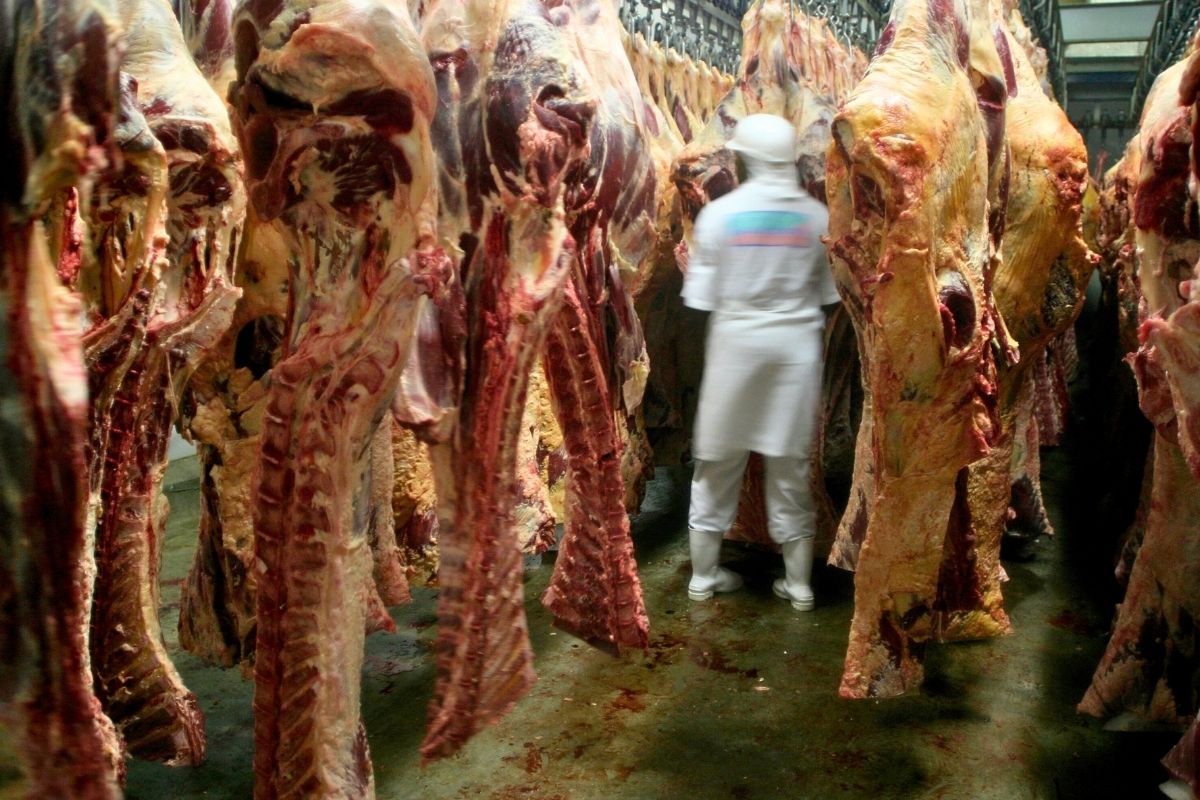
“In my view, what could be simpler than allowing livestock to be slaughtered on the farm and providing consumers with a certificate to that effect, provided the consumers agree to buy it that way. This would clearly state that the animal was slaughtered on the farm, not in a slaughterhouse“,– the farmer suggests.
According to him, if the buyer trusts the producer and knows where and how the animal was slaughtered, such a model could open up more opportunities for small-scale producers.
“This would certainly result in more healthy, good-quality meat on the market and would allow us to bypass the large slaughterhouses, which hold a monopoly. I think it would only be for the better,” – V. Streikus is convinced. He has no major complaints regarding labelling or controls.
„There are challenges, but everything is relatively in order and clear“ – says the farmer.
VMVT: for now, it will be investigating where the greatest difficulties lie
“The legislation sets out requirements that food producers must comply with, but producers have questions about how to implement these requirements in their day-to-day operations. The VMVT becomes aware of such ambiguities through the enquiries it receives and whilst supervising the activities of economic operators“, – explains the VMVT, setting out the rationale for launching the survey.
When asked whether the bigger problem lies in the unclear presentation of information or in the requirements themselves – which may be too complex and too costly for smaller businesses – the VMVT has not yet provided a specific answer.
“The aim of the survey is precisely to ascertain whether the difficulties arise more from requirements that are not set out clearly enough, the practical implementation of the requirements, a lack of guidance, or other reasons. This will be possible to assess more clearly once the survey results have been collected and analysed“,” the agency states in its response.
The VMVT also states that, for the time being, whilst the data collection phase is still ongoing, it is unable to identify which areas pose the greatest difficulties for small-scale producers.
Possibility of legislative changes not ruled out
The VMVT says that the survey results will determine what measures will be taken. If it transpires that the main problem is a lack of information or practical examples, the information and guidance materials will be improved. However, the agency does not rule out more far-reaching changes.
“If the results show that the main issues arise from unclear legal regulation, we do not rule out the possibility of amending national legislation,” says the VMVT.
Nevertheless, the agency acknowledges that it does not have data on how many small-scale producers failed to commence operations, suspended them or did not expand them specifically due to the lack of clarity in legislative requirements or the administrative burden.
“Information on the reasons why an economic operator decides to cease, suspend or not expand their activities is not collected,” states the VMVT. The Authority emphasises that the survey is not merely a matter of seeking opinions.
“The plan is not only to conduct the survey, but also to summarise its results and put forward proposals on how to improve the legislation drafted by the VMVT, methodological materials, and to organise training sessions focused on the topics that have raised the most questions,” explains the VMVT.

Similar articles

Video