

















K. Mažeika’s million-euro show: 64 per cent of recipients received up to 100 euros, whilst 10 per cent received almost two-thirds of the money
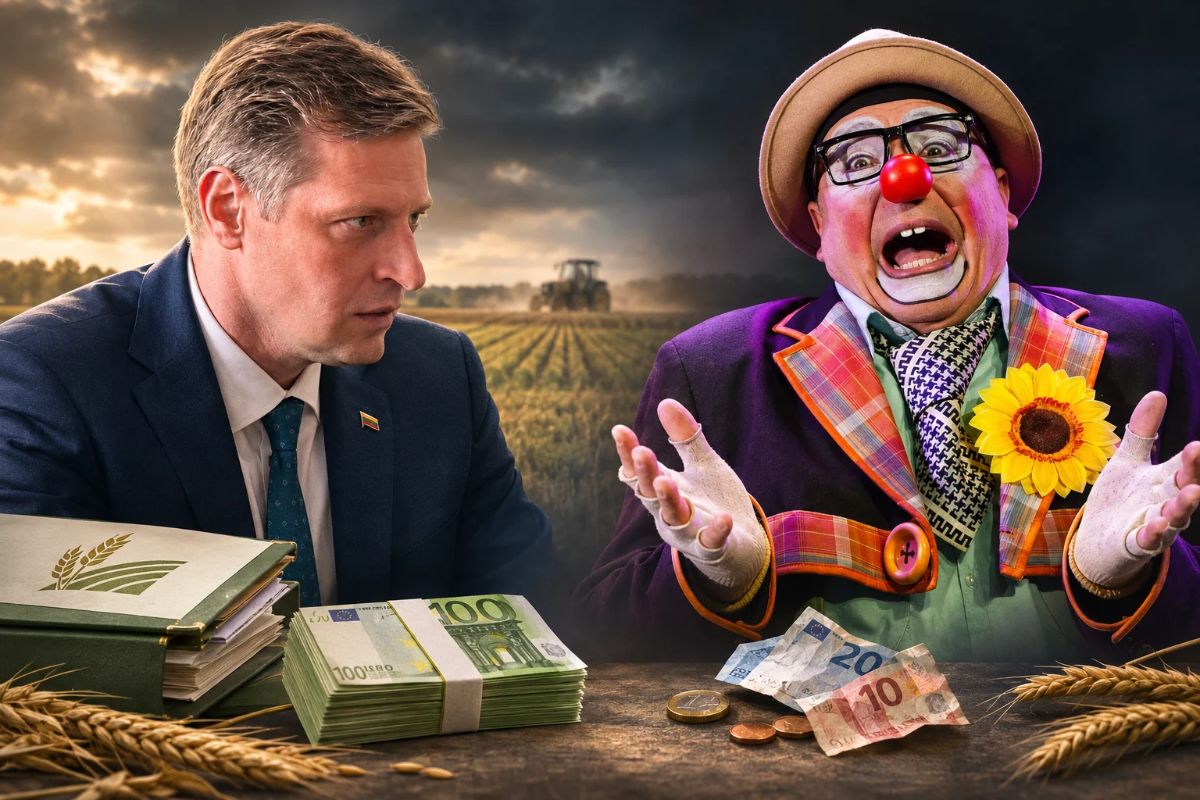
Almost 20 million euros in aid to offset rising fertiliser and fuel prices has already been distributed, and data provided by the National Paying Agency (NMA) offers the first insight into how it has actually been allocated.
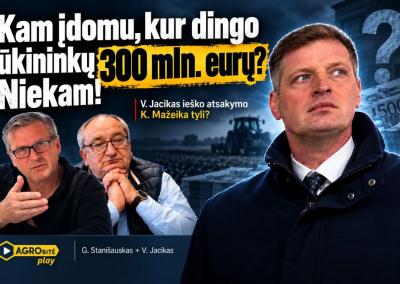
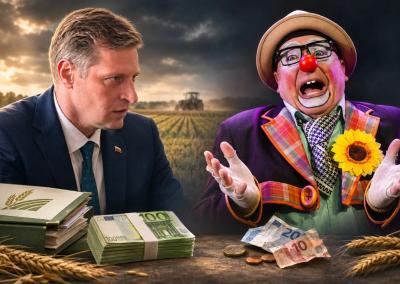
The figures differ significantly from the impression that may have been created by public communications from the Ministry of Agriculture (ŽŪM) prior to the payment of the aid. In September, the Minister for Agriculture, Kęstutis Mažeika, stated that farmers “can expect up to 4,500 euros”, with mixed and medium-sized farms reportedly set to receive the most support. According to the Minister, priority was given to small farms. In October, Deputy Minister Ligita Valalytė was already talking about an average of around 4,000 euros in support per farm. However, the actual average calculated by the NMA stands at 295.15 euros.
Almost two-thirds – up to 100 euros
The NMA stated that support had been paid to 66,051 applicants. The total amount paid out stands at 19.495 million euros. The smallest payment was just 9.96 euros, whilst the largest was 8,529 euros. Even more telling is the breakdown of recipients.
30,125 applicants, or 45.61 per cent of all recipients, received up to 50 euros. A further 12,226 farmers were paid between 50 and 100 euros. Thus, a total of 64.12 per cent of aid recipients received no more than 100 euros. When we add the 14,214 recipients whose payments ranged from 100 to 500 euros, it becomes clear that as many as 85.64 per cent of all recipients received up to 500 euros.
Just 328 applicants – around 0.5 per cent of all recipients – received €3,000 or more. A total of 183 applicants, or 0.28 per cent, received more than the 4,500 euros previously mentioned by the minister. Furthermore, the actual highest payment – €8,529 – was almost double the figure of €4,500 publicly cited by the minister.
Data from the NMA shows a marked concentration of support: the 10 per cent of applicants who received the largest payments accounted for €12.85 million, or almost two-thirds of the total support. The remaining 90 per cent of beneficiaries received €6.65 million – just over a third of the total package.
A similar disproportion is evident in area-based support: out of €16.5 million, as much as €13.4 million went to applicants who declared more than 300 ha. Thus, even after setting a 300 ha ‘ceiling’ on support, the lion’s share of the money allocated for area-based support still went to the group of farms that had declared the largest areas.
The Ministry of Agriculture makes no mention of small payments
“Agrobitė” asked the Ministry of Agriculture how many farmers had actually received the previously publicly mentioned €3,500–4,500 and how such figures had been calculated. The Ministry did not provide a specific answer to this question. The Ministry of Agriculture reiterated the rules on support and stated that information on the actual distribution had already been provided by the National Paying Agency (NMA), so it would not “duplicate” it.
The Ministry was also asked whether, prior to approving the model, calculations had been made to determine how many farms would receive less than 100, 500 or 1,000 euros, and whether payments of a few dozen or a few hundred euros could significantly offset the increased costs of fuel and fertiliser. The response was once again brief: the support was paid out by the NMA, and “Agrobitė” had already received the information.
However, figures provided by the NMA now show that small payments were not isolated cases – almost two-thirds of all beneficiaries received up to 100 euros.
“The aim was to support small and medium-sized farmers”
The Ministry of Agriculture was also asked whether, now that actual payment data is available, the Ministry still believes that the model primarily helped small and medium-sized farms. The Ministry did not provide any specific indicators to support this.
“This decision was intended to support small and medium-sized farms and not to increase the administrative burden,” the Ministry of Agriculture stated. The Ministry therefore explained what it was aiming for, but did not provide any figures to prove that this objective had been achieved.
When asked whether the minister would take political responsibility for the public communication regarding the support of several thousand euros, and whether a minimum payment or criteria better reflecting the economic size of the farm would be considered in future, the Ministry of Agriculture replied that “the minister has set a clear course” – zero bureaucracy and rapid disbursement of funds.
No response was given to the question regarding political accountability and possible changes to the model.
V. Buivydas: what we said can now be seen in the bank statements
Vytautas Buivydas, Vice-Chairman of the Lithuanian Union of Young Farmers and Youth (LJŪJS), states that the actual payments have confirmed the criticism the organisation voiced even before the model was approved.
“Farmers are sharing the payments they’ve received – 20, 30, 50, 100 euros; elsewhere it’s a few hundred. Farmers are starting to voice their dissatisfaction because these small sums are starting to dwindle, whilst in reality almost nothing is actually coming in,” said V. Buivydas. In his view, the chosen formula was not favourable to small farms.
“In a sense, it is a deception when we talk about prioritising family and medium-sized farms. They have been sidelined; they will receive a few dozen or a few hundred euros, whilst the majority of the support will go to those who have 300 hectares of arable land, 300 head of cattle, and to businesses.“, – said V. Buivydas, adding: „Well, it’s a complete mockery. And those who do not have large areas of land but are trying to create greater added value – for example, through orchards, vegetables, berries and so on – are likely to feel particularly aggrieved. They’re left with just €10 per hectare.“
D. Karalevičienė: „Who is this for?“
Danutė Karalevičienė, head of the Lithuanian Association of Users of Infertile Land (LNŽNA), gives specific examples from among her members. One organic farm of around 80 ha received approximately 700 euros.
“700 euros is all well and good. But it’s not much,” she said. Another farm in Samogitia, managing 60–70 ha and keeping around 20 cows – 10 dairy and 10 beef – received around 200 euros.
“So he’s asking – what did he get that support for? Who is it for?” said D. Karalevičienė. She is particularly critical of the situation facing beef cattle farmers and those working on unproductive land. According to the association’s chair, the state has been encouraging such farms to opt for livestock farming for many years, but beef cattle have been left out of this support scheme.
The Ministry of Agriculture, for its part, has stated that the support model was discussed by the College together with representatives of farmers. However, the final figures from the National Paying Agency (NMA) raise a very specific question: if small and medium-sized farms were identified as a priority, how should we assess the outcome when almost two-thirds of beneficiaries received up to 100 euros, whilst 10 per cent of the recipients of the largest payments accounted for almost two-thirds of the total support?
The Ministry of Agriculture did not provide a specific answer to this question.

Similar articles


Video