
































































No GMOs detected in Lithuania in 2025, according to the Plant Protection Service
As every year, the State Office for Plant Production monitors agricultural crops, consignments of plant products entering the European Union, consignments of plant propagating material, flowers, and admixtures of genetically modified organisms (GMO). The GMO monitoring process is strictly regulated to ensure the safety of the public and the ecosystem as a whole.
What will be studied in 2025?
Agriculture specialists in 2025. In the 202020 survey, 91 samples were taken from winter oilseed rape (Brassica napus L) (25 samples), maize (Zea mays L) (24 samples), wheat (Triticum aestivum L) (22 samples, including 18 winter wheat and 4 spring wheat samples), tomatoes (Solanum lycopersicum L), tomatoes (Solanum lycopersicum L) (22 samples), tomatoes from the European Union and the European Union.) (10 samples), sugar beet (Beta vulgaris L), flax (Linum usitatissimum L), soybean (Glycine max (L) Merrill), edible potato (Solanum tuberosum (L) Merrill), potatoes (Solanum tuberosum L) leaves and blue-flowered lucerne (Medicago sativa L) herbage (2 samples each), 11 samples – from consignments of plant propagating material (winter rape – 6 samples, spring rape and seed potatoes – 2 samples each and blue alfalfa – 1 sample), 8 samples – from flowers traded on the Lithuanian market, and 3 samples of blue alfalfa – from crops at risk of GMO contamination entering Lithuania, transiting through Lithuania to other EU countries, and in transit, not intended for human consumption or animal feed. A total of 113 samples have been taken for GMO monitoring in Lithuania in 2025.
GMO monitoring summary
In 2025, the first sampling for GMO monitoring was carried out from edible tomato growers (10 samples in total), following information received from the European Commission on the presence of genetically modified edible tomato seeds from the United States placed on the EU market via social networks. The inclusion of edible tomatoes in the monitoring programme broadens the range of products monitored and strengthens the prevention of risks from potential GMOs among fresh vegetable growers.
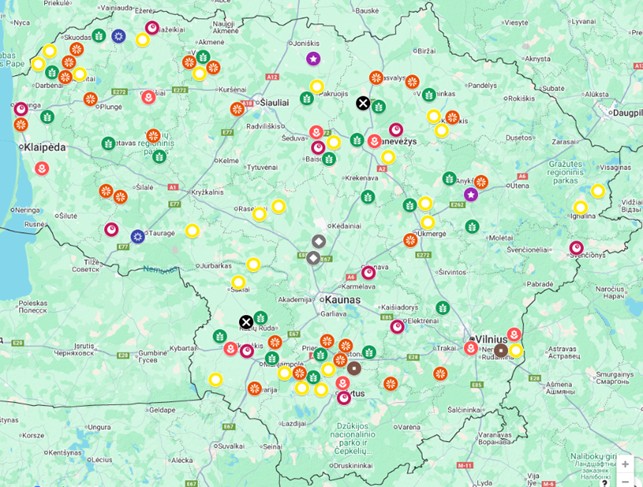
Samples for genetic modification testing were taken from the areas of crops declared by farmers this year throughout Lithuania. Cereal crops are predominant in the country's most fertile regions, where crop production is intensive and farms grow 50 hectares or more of oilseed rape, maize and wheat. Therefore, the largest number of samples were taken by specialists from Klaipėda (10 samples), Kaunas, Šiauliai and Panevėžys (9 samples each) and Vilnius and Marijampolė (8 samples each) regional units from homogeneous and distant crops. In other regions (Tauragė, Utena, Alytus and Telšiai), the number of samples taken for genetic modification testing was slightly lower this year.
From the flowers imported into Lithuania and traded on the Lithuanian market, 5 samples were taken this year from Petunia (Petunia sp. Jussieu) (including 3 samples from large-flowered Petunia and 2 samples from nursery Petunia with risk traits), 2 samples from roses (Rosa sp. L) and 1 sample of true carnation (Dianthus caryophyllus L) (carnation and rose samples were taken in bluish or blue colour, not coloured).
GMO Research Map Signs
Sampling sites and plant species are shown on the map in different colours and symbols:
- Yellow colour – for oilseed rape crops,
- Orange colour – maize crop,
- Green colour – wheat crop,
- Red colour – of imported flowers traded on the Lithuanian market,
- Burgundy colour – of edible tomato growers,
- Black colour – sugar beet crops,
- Blue colour – blue-flowered lucerne grass crops,
- Violet colour – crops of sown flax,
- Grey colour – of soya bean crops,
All samples of crops, flowers traded on the Lithuanian market and consignments (plant propagating material and imported plant products into the EU) were submitted to the National Institute of Food and Veterinary Risk Assessment. We are pleased to report that again this year, no traces of GMOs have been found in Lithuanian crop production farms, consignments and flowers imported into our country and traded on our domestic market. This confirms that Lithuania continues to ensure effective control of GMOs and that the crop production and crops used remain free from unauthorised genetic modification.
Why is this important?
„Monitoring GMOs in Lithuania is one of the key tools to ensure the protection of society and nature and to promote responsible innovation. Strict monitoring allows us to combine progress in agriculture with the development of a long-term sustainable environment, thus contributing to a healthier and safer living environment," said Yuri Kornijenko, Director of the State Plant Breeding Service. This helps to ensure not only the country's ecological and social stability, but also the public's confidence in science and innovation, which can improve the quality of life for all of us. The Plant Protection Service will continue to monitor GMOs consistently, taking into account developments in the agricultural sector, consumption trends, import flows, as well as paying particular attention to important information from the European Commission on the detection of genetically modified crops or propagating material on the market.

Similar articles





Video