




























































VMVT: Milk on Anykščiai farm meets safety requirements, but hygiene must be improved

The State Food and Veterinary Service (VMVT) is monitoring milk testing data as part of its risk assessment on a cattle farm in Anykščiai district. Inspectors were involved in the collection of additional milk samples for laboratory tests and carried out detailed checks on milk preparation processes. The results of the milk tests complied with the requirements of the rules on milk purchases.
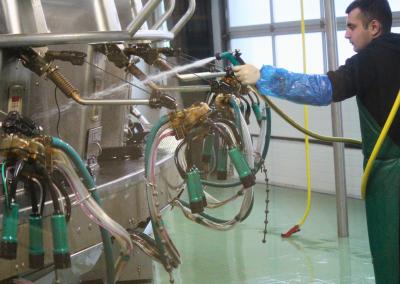
„Currently, the milk produced on the farm does not pose a risk to the consumer, and therefore milk purchases are not suspended. Deficiencies in milking hygiene have been identified on the farm and recommendations have been made to improve this. Milk quality tests are carried out on the farm at least three times a month," commented Vitalija Prašmutienė, Senior Specialist at the Animal Products Division of the Food and Veterinary Policy Department of the VMVT.
On farm, cow productivity is constantly monitored. Milk samples are taken once a month by the assistants of UAB „Pieno tyrimai“ to ensure the quality of milk purchased from the farm.
„According to farmers, an increasing challenge for farms is the availability of a sufficient number of reliable, tidy and honest milkers, as the hygiene of milking depends mainly on their efforts. Our aim now is to help farmers to manage and fully eliminate the non-compliances we have found during our inspections, and to work with them on an ongoing basis to implement the requirements," explains a VVM specialist.
Following the additional milk tests, farmers have been instructed to continuously monitor the health of their cows and to responsibly comply with the hygiene requirements – to ensure that all milking and milk handling processes are carried out in accordance with the requirements.
According to the VVM specialists, the purchase of milk is stopped when its quality indicators do not meet the requirements. If the geometric mean of the total bacterial count and the somatic cell count exceeds the norms for three months, the milk buyer who has recorded this will stop buying the milk and must inform the HVO. Prior to the suspension, the farmer shall be given a period of three months to identify the causes of the non-compliance and to take action to improve the milk quality results. During that period, milk which does not meet the geometric mean of the total bacterial or somatic cell counts shall be subject to a penalty, i.e. a reduced price for the milk. According to the VMVT, for this farmer in the Anykščiai district, milk purchases have not been suspended in recent years.
The MoHFW will continue to monitor the situation on the farm. During the investigation, inspectors are providing instructions and recommendations to the farmer to ensure compliance, and the investigation is ongoing.

Similar articles

Video