











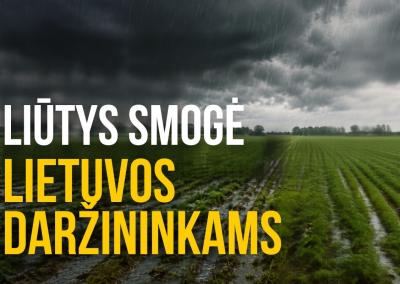
















The fertiliser price storm is just beginning: gas, the war in Iran and Palionis' one eye open

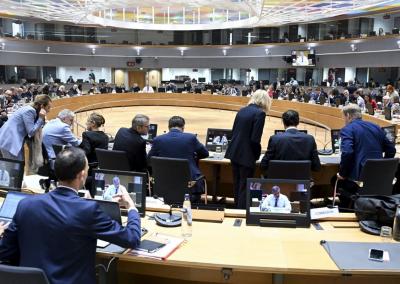
In recent months, the global fertiliser market has been caught in a new whirlpool of geopolitical risks, in which farmers are likely to become increasingly involved. On Wednesday, European Commission head Ursula von der Leyen said that the European Union may consider additional measures to stabilise the gas market in the light of the military action in the Middle East. However, she also warned that artificially limiting gas prices could be risky, as overly aggressive interventions could disrupt supplies and further destabilise the market.
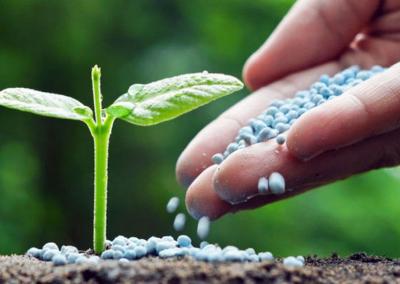
The very fact that the EU institutions are once again considering interventions of this magnitude signals a new cycle of tension in energy markets. This is particularly important for agriculture, as the production of nitrogen fertilisers depends directly on the price of natural gas. As gas becomes more expensive, fertilisers inevitably become more expensive, which means higher costs for crop farms.
The new round of climate regulation in Europe adds to this pressure. From the beginning of 2026, the CBAM (Carbon Border Adjustment Mechanism), which also applies to fertilisers from third countries, became effective. Until now, in 2023–2025, there was a transitional period: importers only had to declare the CO₂ emissions of their imports, but did not have to pay for them. From this year onwards, importers are required to purchase CBAM certificates, the price of which is directly linked to the price of EU CO₂ allowances (EU Emissions Trading System).The aim of this mechanism is to align the carbon price of imported products with the price already paid by EU producers. In practice, however, this also means more price pressure on imported fertilisers. Analysts believe that there are already early signs that regulatory uncertainty and additional costs are starting to reduce or shift some imports to other regions. However, the specific figures for the fall in imports remain highly variable for the time being and are often used as an argument in the political debate on a possible postponement of the CBAM.It should be noted that the structure of the global fertiliser market in general contributes to fertiliser price pressures: a large share of nitrogen fertiliser production is concentrated in a few regions - Russia, the Middle East and North Africa - and energy or geopolitical shocks are quickly transmitted to global supply and prices.
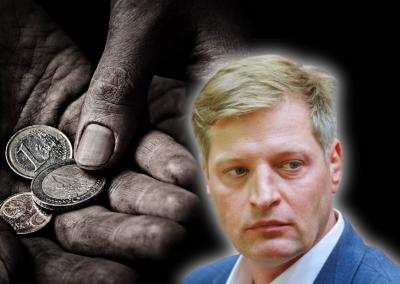
The debate on this mechanism has also galvanised farmers' organisations, which are increasingly trying to pressure the Lithuanian institutions to take a more proactive national stance. Crop farms seem to be at a precipice. Even the Minister of Agriculture, Andrius Palionis, who until now has been commenting on global processes mainly from the outside, has finally responded to the farmers' signals. A few days ago, the Ministry of Agriculture of the Republic of Lithuania announced that Lithuania is in favour of postponing the application of the CBAM to the fertiliser sector.
But the natural question is: why is this voice from the Ministry only now? Where was Lithuania's position when the EU-Mercosur trade agreement was being discussed, which also has potentially significant consequences for European agriculture? Today, the ministry is offering farmers financial instruments in the first place.
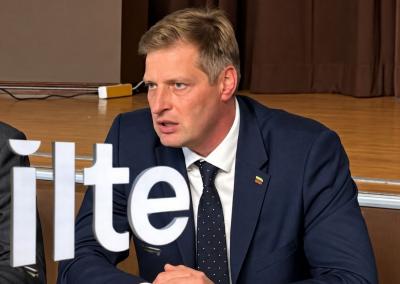
„The possibility of providing soft loans to agricultural operators to replenish their working capital is currently being discussed with the national development bank ILTE. Such a financial instrument would help farmers to ensure the continuity of their activities and to adapt more easily to a difficult economic situation," the ministry said in a statement.
But loans are only a temporary solution. The dynamics of energy prices are a far more important factor. The military action in the Middle East, which started on 28 February, had an immediate impact on the European gas market. TTF natural gas futures prices jumped to around €70 per megawatt-hour, and at the peak reached around €100. Before the conflict, the gas price had fallen to around €30 per MWh. It has now stabilised at around €48 & €50, still well above the level before the escalation of the conflict.
Energy market analysts warn that this could be only the first stage of a shock. Analysts at investment bank „Goldman Sachs“ estimate that if supply disruptions persist for more than two months, European gas prices could rise back above €100 per MWh.
The biggest risk is associated with shipping through the Strait of Hormuz. Before the conflict, around 20% of the world's LNG trade travelled through this strait. Although this represents only a fraction of the total global gas market – much of the gas is still transported by pipeline – this sea route remains critical to global energy logistics.
If the most pessimistic scenario were to occur and shipping in the Strait were to be permanently disrupted, analysts estimate that the price of gas in Europe could rise to around €80-120 per MWh, or around €0.90-1.35 per cubic metre. This would represent a further 70–150% price increase from current levels.This hike would hit the fertiliser industry directly. In the production of nitrogenous fertilisers, natural gas accounts for around 60–80% of the total cost of production. Therefore, even relatively small increases in gas prices are quickly passed on to fertiliser prices.
If fertiliser prices were to rise, this would inevitably have an impact on the cost of cereals. A simple calculation shows that to compensate for the roughly 30% increase in fertiliser prices, crop farms would need to receive at least €18–19 more per tonne for their grain than in 2025. A 50% increase in fertiliser prices would result in a rise in the price of cereals of around €30 per tonne. The alternative is to reduce fertiliser application rates, but this would almost inevitably lead to lower yields.
The situation remains highly uncertain. It is unclear how long the conflict in the Middle East will last, how the war in Ukraine will develop, and what yields will be available in the main grain exporters.
In this context, national agricultural policy should be very active. But so far it seems to be only beginning to wake up. The ministry's comments are mostly limited to commenting on possible threats, but there are few concrete initiatives at government level. We hear more about the need for an audit of the State Food and Veterinary Service and a search for irregularities in the work of the head of the State Food and Veterinary Service, Mrs Mikalauskienė. We also hear that the Agency of Agriculture is doing absolutely nothing, having announced that it has inspected 70 operators for unfair trading practices over the course of 2025, but has never completed a single investigation and has not imposed sanctions. And where are the investigations into unfair practices against milk producers? There are none. The dairy sector is squealing, the agency is "working". Where was Mr Palionis when Romania, along with other countries, was trying to wrest compensation from the EC for its milk producers? He just managed to wave to the EC Commissioner and that was that.
Institutional vacuum in all its glory – currently the ministry does not even have a chancellor, who in many institutions plays an important coordinating role between different policy areas.
But the responsibility is not only with the state institutions. Farmers' organisations themselves also have a certain responsibility. In recent months, they have focused more on internal discussions and funding issues, while the analysis of strategic developments in European policy has often taken a back seat. "Selfies" from meetings with officials are probably not what the community would expect from its leaders. But it is what it is. We have no other leaders.
Today, with geopolitics, energy and climate policy all intertwined in a complex economic knot, it is clear that the agricultural sector is entering a new phase. The fertiliser price storm may only be just beginning, and its consequences for agriculture will depend not only on global markets, but also on the ability of Europe and Lithuania to make timely and strategically sound decisions.

Similar articles

Video