



































Kęstutis Mažeika’s ‘Marketplace of Troubles’: with the abolition of the Food Council, the College’s powers are now merely advisory
In August, the Minister for Agriculture, Kęstutis Mažeika, dissolved the Food Council, whose work he had subsequently criticised for its lengthy discussions that failed to result in concrete decisions. However, the collegium of the Ministry of Agriculture (ŽŪM), which replaced it, does not itself take independent decisions either. The Ministry of Agriculture acknowledges that the fundamental difference between the two bodies is primarily organisational and institutional, rather than the legal force of their decisions.
Meanwhile, farmers’ representatives who have already participated in the Board’s work have mixed views on it. Some see an opportunity to formally present the sector’s arguments and influence future decisions, whilst others, following the first meeting, say they still do not understand who makes the decisions, on what principles, or which social partners are permitted to vote.
Ministry of Agriculture: the Board’s recommendations are not binding
The Ministry confirms that the Board has not been granted independent decision-making powers: “The Ministry of Agriculture’s Board is an advisory body to the Minister, not a body that takes independent administrative decisions”.
The College may consider strategic and cross-sectoral issues, evaluate draft legislation, monitor the market, consult experts, and submit proposals, recommendations, conclusions and resolutions to the Minister. However, none of these are binding on the Minister.
“The Board’s proposals or recommendations are not, in themselves, binding on either the Minister or the Ministry,” confirmed the Ministry of Agriculture.
This status is also provided for in the Government Act – the ministry’s council is an advisory body to the Minister, and its membership and rules of procedure are approved by the Minister himself.
He also submits matters to the College for consideration. According to the Ministry of Agriculture, the main difference between the College and the Food Council is that the College’s remit is not limited to the food sector and may cover the entire scope of the minister’s responsibilities.
There is no deadline by which a proposal must be turned into a decision
The Ministry highlights another element of the new model – monitoring the implementation of the Board’s decisions. The relevant department within the Ministry will be responsible for monitoring their implementation and reporting back to the Board itself on a regular basis. However, there is no guarantee that a proposal endorsed by the Board will be implemented.
“The legislation does not stipulate that, once the Board has approved a proposal, it automatically becomes a decision of the Minister or the Ministry,” stated the Ministry of Agriculture.
Nor is there a specified timeframe within which the Minister or the Ministry must assess the Board’s proposal. According to the Ministry of Agriculture, the final decision is taken by the Minister or another competent body as provided for by law.
The Ministry will also not be obliged to publicly disclose which of the College’s proposals the Minister ultimately approved, which were rejected, and why. Only the resolutions and minutes of the meetings should be made public, setting out the participants, the issues discussed, the gist of the statements, the voting results and any dissenting opinions.
V. Buivydas: so far, more questions than answers
Vytautas Buivydas, Vice-Chairman of the Lithuanian Young Farmers’ and Youth Union, has concerns about the College’s voting model itself. Two main issues were discussed at the first meeting. According to V. Buivydas, the social partners with voting rights varied depending on the issue.
“On one issue, certain social partners had the right to vote; on another, it was different partners. We tried to ask who would be involved and how it would work; it seems that the Ministry itself will assign the relevant social partners to specific issues ", he says.
Even before the Board began its work, the Ministry of Agriculture publicly announced that representatives of social partners and other organisations invited to meetings, depending on the nature of the issue under consideration, would acquire all the rights and duties of College members during the meeting.
The Ministry is now explaining to “Agrobite” that the organisations’ participation is linked to the sector they represent and the content of the specific issue. There is no separate set of criteria in the regulations for the public selection of invited organisations. It is precisely this that raises doubts for V. Buivydas.
“When you both set the question and choose who can vote, the question is how we will focus on that broader outcome,” he muses.
„That train is already moving“
The vote on the professional qualification requirement for new farmers raised even more questions for the representative of young farmers.
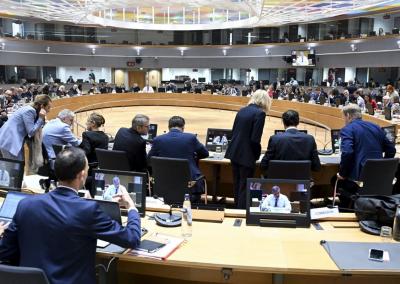
At its first meeting, the Board approved the proposal to scrap the requirement to obtain a minimum level of professional training in order to register a farm. The Ministry of Agriculture publicly presented this decision as a measure to reduce the administrative burden.
V. Buivydas says he did not agree with this position. According to him, the ratio of votes between the social partners and the ministry’s representatives also highlighted another feature of the Board – the ministry itself may have the final say.
“How can we call this democracy when we have shown our disapproval both through our arguments and our vote, yet the Ministry of Agriculture retains the final say and that decisive vote?”, he says. He emphasises that he is not opposed to the format of the dialogue itself, but would like clearer rules that are understood by everyone in advance.
„One shouldn’t say that the farmers decided, or that the farmers have made the decision, because very often we are thrown into that decision-making process, but essentially – whether you vote or not – that train is already moving,” – says V. Buivydas. In his view, following the first meeting, the model of the College has not yet been fully developed.
G. Špakauskas also sees practical benefits
Gedas Špakauskas, chairman of the Lithuanian Farmers’ Union, takes a far more pragmatic view of the Council. He states that the Food Council’s remit was narrower – mainly relating to food prices, availability and the food supply chain.
“The College is like an officially established working group, which provides an opportunity to address certain issues,” says G. Špakauskas.
Although the Board’s decisions are formally advisory, the head of the LŪS regards the experience of the first meeting as proof that its position can have a practical impact.
“At the very least, the College’s first meeting showed that, yes, it does. Votes are taken on certain decisions, and the outcome of those votes finds its way into legislation,” he says.
However, G. Špakauskas also acknowledges that the College is not an independent decision-making body.
“It is, after all, a ministry; we are guests. We cannot simply come up with, raise any issue, vote on it and expect it to become legislation. The process is more complex,” notes the LŪS chairman.
In his view, even in cases where the social partners’ proposals do not become legislation, the dialogue itself is valuable, as the Ministry receives first-hand information about the situation on farms.
Could this also become a political instrument?
Political scientist Lauras Bielinis also views the establishment of the Council as a management tool for the Minister.
“The Minister of Agriculture is, in fact, creating instruments for himself, with the help of which he can organise and control activities. He needs instruments that are, to some extent, more subordinate to him and loyal to him. That is, ones which he understands, can see and can therefore control“ – says the political scientist.
This does not in itself mean that the Council was created for political communication. However, in L. Bielinis’s view, institutional dialogue with farmers’ organisations also gives the minister the opportunity to build a direct relationship with a key audience in the agricultural sector, particularly in the run-up to the 2027 local elections.
“Any form of communication, dialogue or discussion really does help both sides to understand one another. It is clear that this should not be a bitter dispute; it must be a dialogue aimed at finding common ground. If the minister succeeds, he will win big in the elections“,” – notes L. Bielinis, adding: „Creating an instrument that is accountable to oneself is very important, because whoever comes to the ministry realises that the system operates in parallel with the minister’s interests and does not always align with his objectives.„
In a year’s time, he promises to assess not the number of meetings, but the number of proposals implemented
“The true value of the collegium should be assessed not by the number of discussions or meetings, but by the subsequent implementation of documented proposals and their impact on the decisions of the Ministry (the Minister),” – states the Ministry of Agriculture.
According to data provided by the Ministry, organising the first meeting cost 126.65 euros – this sum was spent on refreshments during the meeting. The work of the Board’s members is unpaid, and there are no procedures in place for the reimbursement of travel or other participation expenses.
V. Buivydas says he wishes to give the Board time for now, but ultimately links its purpose to the results achieved.
“After the next meeting of the Board, we’ll see what answers we receive. If it’s just another ‘complaints fair’ and nothing but talk, we face these problems every day. We need someone to listen to these problems. And we need solutions. We mustn’t just complain. There are plenty of problems, but few who are willing to listen to them. So if we keep getting together just to complain, with no results to show for it, then the purpose of the council will be lost“, he says.

Similar articles



Video