




























































Ahead of the harvest – a new levy on grain growers is causing a stir: farmers are asking whether this is fair.
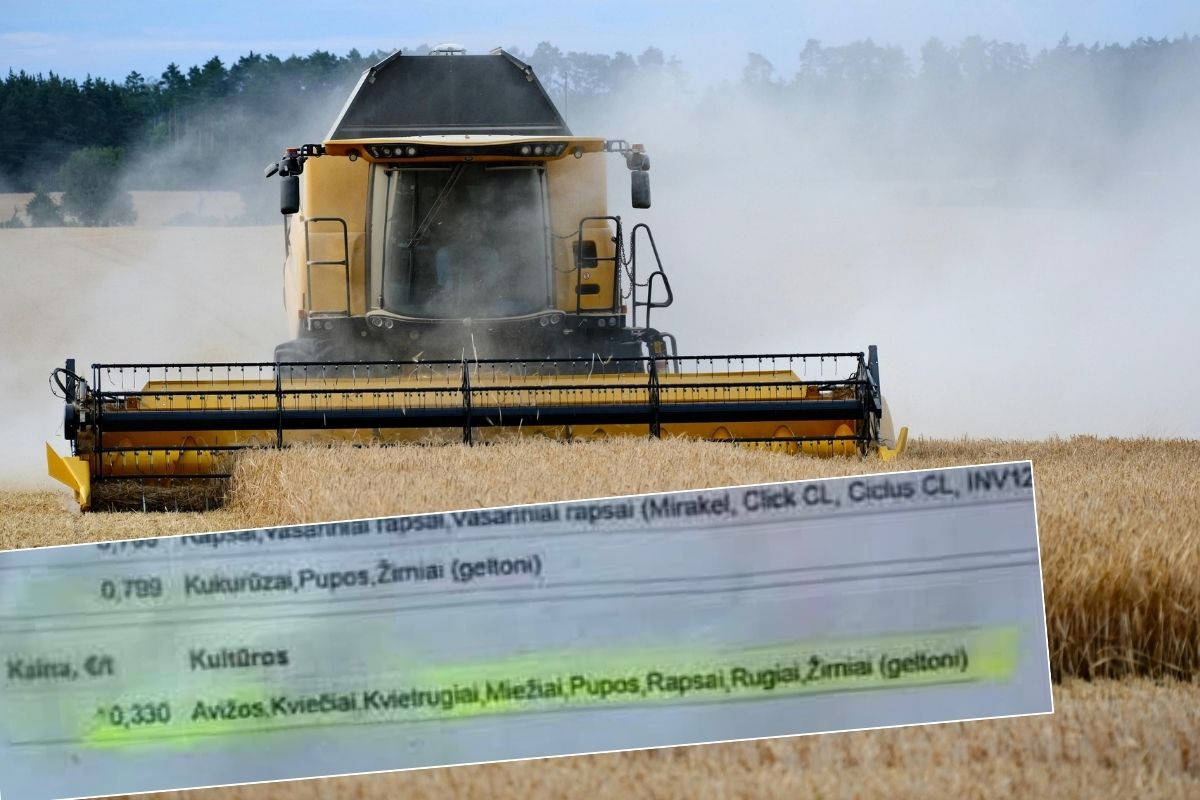
With the grain harvest approaching – a time when farmers enter the most crucial phase of their annual work and the results of their year-long efforts become apparent – the Radviliškis District Farmers’ Union has publicly expressed concern over what it describes as a new charge introduced by the company “Agrokoncernas”. According to farmers’ representatives, from now on a fee of 0.33 euros per tonne of grain sold is to be charged for a sealed grain sample, to which VAT is added.
According to the Farmers’ Union, the fee is calculated not on the basis of the sample actually taken and sent to the laboratory, but on the total quantity of grain sold. The organisation estimates that if this procedure were applied to all grain purchased by the company, the annual revenue could reach around half a million euros.
The Radviliškis Regional Farmers’ Union points out that a sealed sample is an important tool in cases of disputes over grain quality. This procedure allows a farmer who disagrees with the quality indicators set by the purchaser to request an independent laboratory analysis. The organisation raises the question of whether the additional fee will reduce farmers’ willingness to make use of this option and whether this will undermine a more transparent grain quality assessment system.
Another issue raised by farmers is that the new conditions are reportedly being applied to grain purchase and sale contracts signed previously, even though, according to the organisation, farmers were not informed of such a fee in advance. According to the union, this raises doubts about compliance with the principles of fair business relations.
The report also highlights payment practices. According to the farmers, when the option to pay for agricultural produce within two months became available, “Agrokoncernas” was one of the first companies to start applying a longer payment term for the produce it purchased. At the time, according to the Radviliškis Region Farmers’ Union, the payment term for farmers purchasing goods themselves remained unchanged – one month – and interest is charged once this period expires.
The Radviliškis Regional Farmers’ Union argues that this practice raises questions about the balance of business relations and calls for a discussion on whether additional charges and unequal payment terms contribute to an even greater financial burden on farmers during the crucial harvest period. Meanwhile, the company’s own position on the farmers’ complaints has not yet been announced at this stage.
Grain growers: terms favourable only to partners are being imposed
The Lithuanian Grain Growers’ Association (LGAA) has also reacted to the situation; its chairman, Audrius Vanagas, stated that “instead of discussing and explaining that in the agricultural sector, which generates half of the total agricultural output in Lithuania, the procedures for sampling, testing and storage must be transparent, clear and unambiguous, they are choosing the path of confrontation".
“We are also hearing of forthcoming decisions from other partners which will reduce farmers’ bargaining power and impose conditions favourable only to the partners (...) We hope that the Minister for Agriculture, Kęstutis Mažeika, and his team will take note of this and seek ways to resolve the issue,” wrote LGAA Director A. Vanagas on social media.
“Agrokoncernas grain”: we inform customers clearly and in advance about the prices applied and any changes to them
“Agrobitė” has approached “Agrokoncernas” for comment on the situation that has arisen. We are publishing the response received from Tomas Urbonas, Head of Grain Procurement at UAB “Agrokoncerno grūdai”:
Despite lengthy discussions among the interested parties – grain growers, the Ministry of Agriculture, grain buyers and others – and the comments submitted by purchasers, which were not taken into account, amendments to the procedures for the sampling and storage of grain were approved. These came into force on 20 January 2025 and imposed additional obligations on all grain buyers.
Under the current procedure, the seller or their representative must be given the opportunity to observe the preparation of the laboratory sample, and the sample must be sealed in the presence of the seller or their representative. The previous procedure did not require all samples to be sealed, including cases where the customer agreed with the results of the grain quality tests carried out by the laboratory. Under both the previous and current procedures, the vast majority of customers agree with the results of the quality tests carried out by the laboratory.
According to data from the previous season, over 100,000 units of equipment were serviced at the company’s grain silos. Only around 60 samples were sent for arbitration quality testing. The results of the majority of the arbitration tests remained unchanged, or the differences found did not exceed the permissible margins of error. A dozen or so test results were more favourable to customers, but only in rare cases did this result in a change to the grain quality grade. The results of some of the arbitration tests were poorer than those obtained in the company’s laboratories. These findings merely confirm that grain quality is assessed responsibly and transparently in the company’s laboratories. We would like to emphasise that, under both the previous and current procedures, grain suppliers are guaranteed the opportunity to have a sample retested without it being sent for arbitration testing.
In order to ensure the transparency and traceability of the process, even before the new procedure came into force, the grain weighing and quality assessment processes were filmed at all of the company’s grain silos. We continue to do so, and we store the video recordings so that, should any issues arise, we can objectively assess the specific situation.
Under the current regulations, laboratory samples must be stored for at least 48 hours from the time the tests are carried out, with the period calculated from 00:00 the following day, excluding non-working days. The previous regulations stipulated a 24-hour sample retention period.
For example, under the current regulations, if a supplier delivers grain on a Friday morning during the season when reception takes place at weekends, we, as purchasers, are obliged to store the samples until the following Tuesday morning. In such cases, large grain silos may need to store around 1,500 sealed samples at any one time. To ensure this process runs smoothly, it is necessary to have or set up additional sample storage facilities; where these are not available, as is the case in some of our grain silos, we must purchase, fit out and use shipping containers.
Compliance with these requirements also entails additional costs: each sample must be packed, sealed, labelled, registered, made traceable and stored in suitable facilities. This process also requires additional staff time and administrative resources. Despite the allocation of additional staff, premises and other resources to ensure the smooth running of this process, the biggest challenge – particularly during peak season – remains the time customers spend waiting in queues.
Following the end of last year’s grain procurement season, we put forward proposals to simplify the current procedure, based on our practical experience. One of these is to seal samples only in cases where the customer disagrees with the results determined by the laboratory. Such a solution would reduce the costs of the process and the time spent by customers several times over, whilst preserving their right to disagree with the test results and thus protect their interests.
Having failed to secure support for the simplification of the procedure, and in order not to infringe on clients’ rights and to ensure the transparency of our services, we have assessed the costs incurred by the company. Any additional costs to customers arising from compliance with these requirements will be shown as a separate line item. The fee has been set following an assessment of the technical, organisational and human resources required for the sealing, registration, traceability and storage of samples, as well as for the administration of the entire process. The calculation was based on the actual volume of the company’s grain elevator operations and the costs of the process.
The fee will not apply to contracts concluded before it comes into effect – it will only apply to newly concluded contracts. In this way, we ensure that the contractual terms already agreed with customers will not be altered.
We uphold transparent grain quality assessment and comply with all applicable requirements. We would also like to emphasise that we have not increased the rates for grain drying and cleaning services, even though the price of gas has doubled and wages and other operating costs have risen. Long-term cooperation with farmers is important to us, which is why we inform our customers clearly and in advance about the prices applied and any changes to them.
With regard to payment terms, we would like to point out that all payment conditions, including deadlines and the procedures for their application, are clearly set out in the contract and comply with current legislation. We do not limit ourselves solely to the deadlines set out in legislation or the contract – we do not delay the payment process and usually pay for delivered produce earlier than stipulated in the contract. We are flexible and take our customers’ needs into account in a spirit of goodwill.

Similar articles




Video