



























ESO has promised to compensate farmers not only for the electricity they have not received, but also for their direct losses

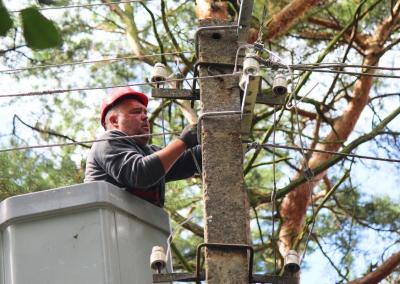
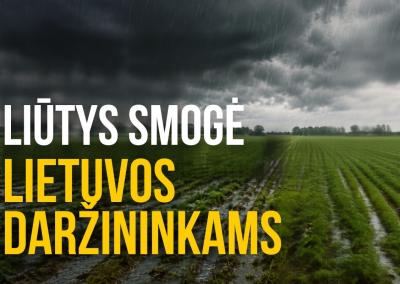
The storm that swept through Lithuania on 22 August caused power supply disruptions for more than half of ESO’s customers engaged in agricultural activities. According to the company’s data, out of the 8,700 farms registered on its system, around 4,600 lost power, whilst electricity supply was only restored to 661 farms after more than 72 hours.
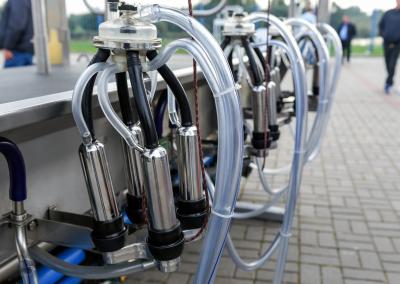
Whilst ESO is counting the affected customers and reminding them of the compensation procedure, dairy farms report that on the first day they had to simply pour away the milk, whilst cooperatives sought ways to salvage at least part of their production. However, ESO notes that some farmers may also apply for individual compensation for the losses they have suffered.
On the first day, some farms had to pour their milk away
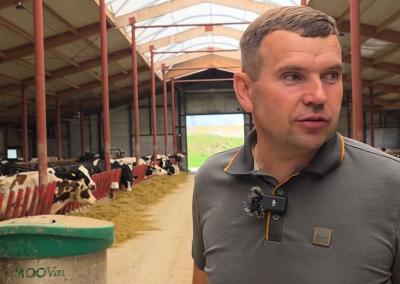
Jūratė Dovydėnienė, director of the “Pieno puta” agricultural co-operative, said that the situation was critical after the storm.
“On the first day, some farms poured their milk away,” she said. “On Monday morning, almost half of the farms were without electricity, and a large proportion still are,” she noted when interviewed a few days after the storm.
According to the director, farmers tried to cope in their own ways: „Those who have generators are trying to get by with them. Admittedly, no one has particularly powerful generators. They’re either milking or chilling the milk.
To preserve as much milk as possible, the co-operative itself has also become involved in resolving the issue.
“We’re transporting milk from farms that have no electricity to those that do, or to our milk collection points. We make these deliveries a couple of times a day so that as much milk as possible can be chilled,” explained the director of the “Pieno puta” Agricultural Cooperative.
“We’ve been organising milk collection for the second day running. Why were we unable to do this on the first day? Quite simply because of mobile network disruptions – we were unable to contact the farms,” noted J. Dovydėnienė.
It wasn’t just the farms that suffered losses
“It’s not just the farms that are suffering losses, but the co-operative itself. Additional transport costs, staff wages… The co-operative now collects milk twice a day, whereas previously it did so every other day. The fact is that costs are higher“,” said the director of the “Pieno puta” Agricultural Cooperative, when interviewed.
She was reluctant to put a figure on what the potential losses might be. Furthermore, J. Dovydėnienė doubted that the compensation provided for by law would cover the actual losses incurred.
“I don’t think so at all. The co-operative certainly won’t be compensated by anyone for the additional costs of the extra work. If I were personally in this situation, I would think that this ESO compensation is intended only for domestic consumers who may have suffered losses due to a malfunctioning freezer, but certainly not for farms“,” – she is convinced.
ESO: automatic compensation will be paid to 661 farms
ESO states that, of the 4,600 farming customers who experienced power supply disruptions, 661 had their power restored after more than 72 hours. It is precisely these customers who will automatically be awarded compensation for the delay in restoring their electricity supply.
“These customers will be awarded compensation for the delay in restoring their electricity supply, and the amount will depend on the customer’s electricity consumption and the duration of the outage at the premises. The specific amount of compensation consists of a fixed component of 30 per cent of the transmission service charges paid and a variable component of 0.7 per cent for each additional hour of delay“, – the company states. However, this is not the only possible method of compensation.
ESO emphasises that farmers may also claim compensation for other losses incurred due to the power supply disruption, but this will require the submission of an individual claim.
„Business customers may contact ESO regarding individual compensation and claim for losses incurred due to a power supply disruption, including losses incurred during agricultural activities, such as spoiled milk, disruptions to the grain drying process or disruptions to livestock management processes“, – ESO states in its response.
The company emphasises that each case will be assessed on an individual basis.
“It is important to specify in the application, in as much detail as possible, the damage suffered, its extent, the circumstances and the link to the power supply disruption, and to provide any supporting documents and other factual evidence available. Each such claim is assessed on a case-by-case basis“, notes ESO.
However, the company did not respond as to whether additional costs such as generator hire, fuel for the generators, additional milk transport or extra staff pay could be reimbursed on a case-by-case basis.
“We were left completely on our own to sort out our problems”
Whilst ESO is urging farmers to gather evidence and submit claims for individual compensation, J. Dovydėnienė said that practically no help was received in the first few days after the storm.
“We were left completely on our own to deal with our problems,” – she explained, adding: „A few farms said they received generators from Anykščiai Municipality, but nothing else.“
ESO, for its part, insists it understands that power supply disruptions can have particularly severe consequences for the agricultural sector.
“We understand the farmers’ concerns – electricity is an essential part of the technological processes involved in many agricultural activities, so a prolonged power cut can have direct consequences for operations ", the company states.
It also emphasises that, following the storm, it is assessing options for improving the resilience of the grid and plans to continue replacing overhead lines with underground cables at a faster pace in the future.

Similar articles

Video