





























A person who has touched bread will always be a better person
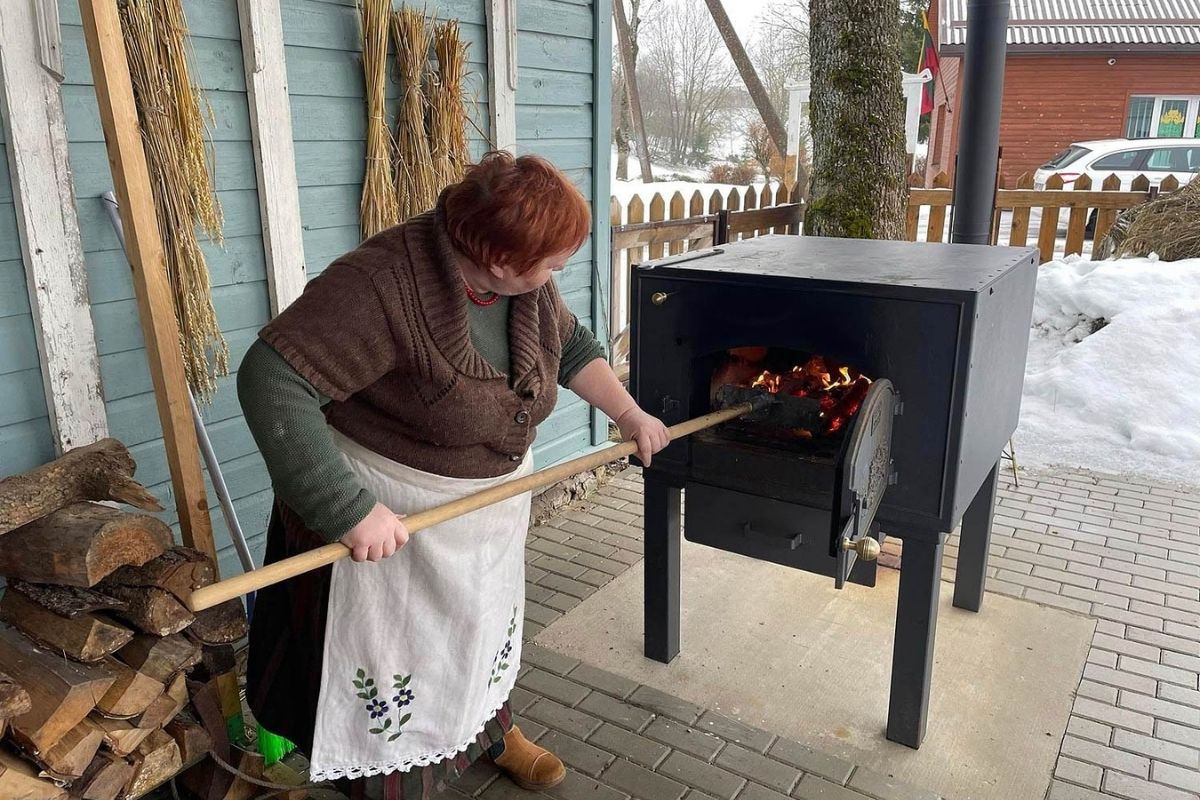
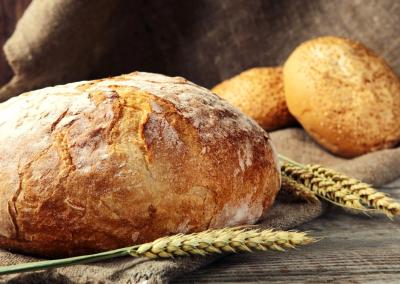
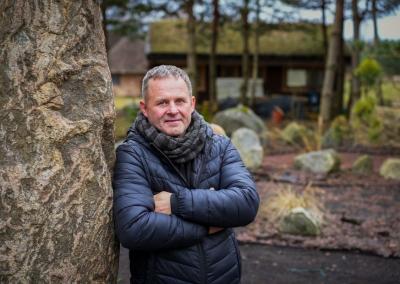
Rye bread preserves our nation’s genetic memory. Not everyone is blessed with the inspiration, talent and courage to understand the mysterious rye and appreciate its value. Baking bread is not a choice, but a calling, in which there is always a deep connection with the traces left by our ancestors and our personal memories. Tourists travelling along various routes in the district almost always stop by the Daugėliškis community centre, where they are welcomed by chairwoman Indrė Gruodienė – energetic, enthusiastic, results-oriented, and someone who has successfully tried her hand at various activities. Today, on Indrė’s table, lies a loaf of rye bread – a symbol that liberates and unites people, giving new meaning to the art of understanding traditions, and revealing much about her character. Baking bread in a community is like therapy, or the barely audible, protective murmur of our ancestors.
Indre, do you remember the first time you tasted homemade bread? What was the slice like?
What remains with us from our childhood moments is what we smell, taste, touch and hear. For me too, perhaps from the age of about seven, the smell and taste of black rye bread have stayed with me. The village of my childhood – Gruzdžiai (Šiauliai district). I remember how my grandmother or grandfather would unwrap the loaf from a white cloth and cut a whole slice slightly diagonally. Then another slice – from the other side, as if trying to even it out. But it never quite worked out.
It was fascinating to watch. It was fun to taste the sourdough bread with my finger: I’d stick my finger in as deep as I could so that as much bread as possible would stick to it, pull it out and lick it like ice cream. Then again… And the old woman would say: “Don’t eat it, or your breasts will grow.” But I would just smile. I also remember how my grandfather, on his way to milk the cow, would cut off a thick slice, put it in a white cloth bag and give it to the cow before milking. I also used to enjoy playing this game: I’d scoop a spoonful of lard from the bucket, spread it thickly on the bread, chop some garlic and sprinkle it with damp salt. Then I’d pile up a stack of children’s books next to me and eat whilst leafing through them. If I ran out of bread but hadn’t finished the books, I’d spread another slice. If I run out of books but there’s still bread left, I start reading the books all over again. And so on until I’m full. I also used to like spreading thick sour cream on my bread. I also used to look forward to Grandma baking a ‘crow’. It was a small loaf into which she would place a fresh chicken or turkey egg in its shell and shape it into the form of a crow. We children would eat it hot. My grandmother taught me that if bread falls on the ground, you must kiss it. And I taught my own children the same.
Why did homemade bread come into your life and become such a central part of your activities? What were your first loaves like?
From childhood memories, and because real bread, kneaded by hand and baked in a wood-fired oven, has energy and is healthy. When I was raising my children, I once tried baking bread out of necessity. It turned out a bit hard. I delved into the finer points of baking: I asked the elders, and it was as if my memory was guiding me by the hand. And every time I bake bread – it’s like a challenge – it depends on the leavening, the ambient temperature, how the oven is fired up, and positive emotions. And even now I couldn’t say I bake perfectly, but whoever tastes it praises it.
And how did the bread-baking classes come about, how do beginners get to grips with rye? How are the secrets of bread-making revealed?
People share what they know. In doing so, they improve themselves and pass on their knowledge to others. The church in Daugėliškis is named after St Joachim and St Anne, and as St Anne is the patron saint of bread and summer harvests, the community came up with the idea of reviving the traditions of the bread-making journey. In the Daugėliškis Regional Community Museum, you can see traditional tools, grind grain with a millstone, and bake bread in a traditional oven. Educational activities for children and adults take place here. Everyone can bake a loaf of bread, and even a so-called “varnas”, hear interesting stories, and listen to live music.
I am currently taking part in the “From the Earth to the Table” programme – part of the Culture Pass scheme. I lead educational sessions for the long-term unemployed and for participants in the Family Crisis programme. It’s quite moving when a man struggling with addiction, completely absorbed in the task, shapes and decorates his loaf, and when asked what he remembers most, says: “The feeling when I was kneading the bread.” That is what matters most: that a person who has touched bread will always be a better person.
Traditionally, we celebrate St Agatha’s Day together with the Daugėliškis Library. This year, we were visited by the women from the “Rudenėlis” club at the district council’s public library. They shared so many interesting stories that even I hadn’t heard before. And most importantly, they confirmed that in our region too, we used to bake bread with an egg. Pranutė Milašauskienė-Luneckaitė from Žvengliškė village (N. Daugėliškis parish) recalls how her mother, whilst baking bread with caraway seeds, would place a fresh chicken egg in its shell. “Oh, my goodness, how we children used to wait for it to bake; we’d even break it open whilst it was still hot, look for the egg and eat it. It was such a joy. We lived very poorly; we ground the flour ourselves with a millstone, and sold some of it,” recalled Pranutė.
Does the modern woman who bakes bread carry the code of past generations? Is she fulfilling her mission?
Yes. The mystery of rye reveals the worldview of past generations. A slice of rye bread, strengthening human existence, connects us to the distant past and unites us. The modern woman who bakes bread pays tribute to the earth and to all the generations of women in her family who kneaded and baked before her.
As long as homemade rye bread is baked, our genetic memory is preserved and kept alive.

Video