


































































How can you make the most of rainy days in the garden? Useful tasks worth planning in advance

Rainy days may seem like a forced break to many gardeners, but they can actually be one of the most productive periods of the whole season. You just need to know in advance which tasks are best and safest to carry out when the soil is damp and the rain is just a light drizzle.
This kind of planning helps you make the most of Lithuania’s short growing season, avoid rushing in spring and autumn, and protect your plants from stress and disease. What’s more, by shifting some of the work to rainy days, you’ll have more time during dry spells simply to enjoy your lush garden.
Which tasks are best left until it rains?
Firstly, it is worth distinguishing between tasks that are best not undertaken on wet ground and those that actually turn out better in wet weather. On heavier, clayey soil, you shouldn’t walk or dig intensively whilst it’s raining, as you’ll compact the structure and the roots will lack air.
However, there are tasks that are actually most conveniently carried out at such times: these include inspecting young trees and shrubs, weeding where weed roots are deeply embedded, and precise application of slow-release fertilisers. Moist soil yields more easily, and the plants’ response to the additional nutrients is more consistent.
Weeding and mulching in moist soil
When rain has moistened the soil, weed roots loosen and are easier to pull out along with their entire root system. This reduces the likelihood of them growing back in the same place after a few days.
It is important not to rush and to try to tread on the bed as little as possible, especially if the soil is heavier. It is better to lay down planks or old bricks and walk on them, so that the weight is distributed over a larger area and the soil becomes less compacted.
It is a good idea to use the weeds you have pulled out straight away as mulch, provided they do not contain mature seeds. By spreading a 5–7-centimetre layer around fruit trees or berry bushes, moisture will be retained in the soil for longer, and it will be much harder for new weeds to break through.
Fertilising on rainy days
Rain helps to distribute fertiliser more evenly around the root zone, so this is a good time to use granular organic or mineral fertilisers. They are easy to scatter around fruit trees, berry bushes and ornamental shrubs when the soil is already moist but not yet waterlogged.
Care should be taken when applying liquid fertilisers during rain, as heavier rain can wash nutrients down into deeper layers where the roots cannot reach them. It is better to use such products when short, light showers are forecast, or to apply them after rain when the soil is well-soaked.
Do not use large single doses in the hope of ‘feeding the plants for the whole year’. It is more beneficial for plants to have their nutrition supplemented in smaller portions several times over than to cause sudden spikes in salt concentration in the soil.
When should you plant and transplant during rain?
A rainy day is suitable for most planting tasks, provided it is not very cold or windy. Seedlings experience less stress, their leaves are not scorched by the sun, and the soil naturally cradles the roots when you gently press it down with your palms.
Fruit trees, berry bushes and perennials, whose root systems are minimally disturbed during planting, take particularly well on rainy days. It is important to choose a time when the rain is of moderate intensity and there are no puddles around the planting hole, so that the roots are not deprived of air.
When transplanting seedlings into the garden whilst it is raining, try to disturb the wet soil as little as possible and prepare the planting holes in advance. This will reduce the risk of soil compaction and minimise the time the roots are exposed to the air.
Greenhouse and rainwater system
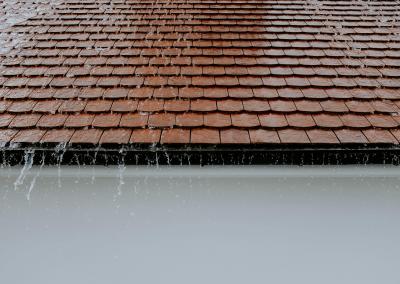
On rainy days, it is a good idea to check how your rainwater collection system is actually working. You can clearly see where the water is running off, and whether the downpipes are directing the flow straight towards the foundations or the edge of the greenhouse, where puddles form.
At such times, it is easy to decide where to place additional containers and what size they should be. Rainwater collected during a summer drought becomes one of the most valuable resources for watering more delicate plants, especially those grown in pots and hanging baskets.
Rainy days in the greenhouse are a good time to check the ventilation openings, the seal on the doors and the condition of the paths. If water is pooling on the paths, you should consider installing drainage or a covering to prevent constant damp inside, which encourages fungal diseases.
A gardener’s tasks under cover
Not all useful gardening tasks need to be carried out outdoors. When it’s raining heavily and it’s best not to disturb the soil, you can take your time planning your crop rotation, reviewing last season’s notes and adjusting the layout of your beds.
This is also a good time to organise and sharpen your garden tools, and to check your hoses, connectors and the operation of your drip irrigation system. If you sort these things out on rainy days, you’ll avoid any unpleasant surprises during sunny spells, when you realise in the middle of a heatwave that a hose is leaking or the sprinklers are blocked.
It’s handy to germinate seedlings that take longer to grow under cover, and to prepare potting mixes and pots. Damp air and lower temperatures are often more favourable for seed germination than the scorching sun on a windowsill.
Safety and protecting plants from disease
When working in the rain, it is important to ensure not only comfort but also safety. Slippery tiles, wooden steps and slopes can be hazardous, so it is advisable to wear shoes with a rough sole and avoid sudden movements on wet surfaces.
Checking your plants more frequently on rainy days helps you spot the signs of fungal diseases in good time: spots on leaves, mould on berries or fruit, and soft rot. Once the first symptoms are noticed, it is easier to remove the affected parts and prevent the disease from spreading throughout the garden.
It is not worth using chemical plant protection products in the rain, as they will be washed away and may end up in the soil and surface water. If spraying is necessary, it is better to choose a dry but not hot day, and during rain limit yourself to maintenance work: pruning, collecting and removing diseased leaves or fruit.
By planning your work around the weather forecast, rainy days can turn from a hindrance into an ally. This way, the garden receives more consistent care, and the gardener manages to avoid a marathon of work during a short, sunny weekend.

Similar articles



Video